


We talk a lot about tools, controls, and frameworks when we talk about cybersecurity culture.
We measure click rates. We deploy new authentication methods. We refine policies.
But one factor shapes everything people do long before a threat reaches your systems: how safe they feel at work.
In cybersecurity, psychological safety is a condition for how information flows:
If people hesitate to report a suspicious email because they’re afraid of looking foolish, detection slows down.
If managers avoid admitting uncertainty during an incident, coordination suffers.
If mistakes are punished instead of examined, risk goes underground.
A strong cybersecurity culture isn’t built only through awareness training. It’s built into how uncertainty, mistakes, and risk signals are handled in everyday work.
Psychological safety: buzzword or risk control?
Psychological safety is the shared belief that a team is safe for interpersonal risk-taking, that you can speak up, admit a mistake, or raise a concern without fear of punishment or ridicule.
Research by Amy Edmondson at Harvard Business School established it as a stronger predictor of team learning and performance than capability alone.
The term is everywhere. Teams talk about creating safe spaces, while their leaders promise openness. But psychological safety is often misunderstood.
It is not:
Comfort or the absence of difficult conversations
A positive team atmosphere or lively culture
Avoiding difficult conversations
Protecting poor performance
In a cybersecurity context, it means something much more specific: people feel safe enough to surface risk before it compounds.
| What psychological safety means | Why it matters for cybersecurity culture |
|---|---|
| People can say “I’m not sure” | Uncertainty surfaces early instead of becoming hidden risk |
| Reporting is encouraged even if it’s a false alarm | Detection improves through speed and volume |
| Mistakes are examined, not weaponised | Learning cycles strengthen |
| Leaders admit blind spots | Transparency becomes normal behaviour |
That matters because most cyber incidents don’t begin with dramatic failures. They begin with small signals:
A strange login
A confusing request
An unusual invoice
A misconfigured setting
If people do not feel safe raising those small signals, you lose visibility.
Psychological safety is a security control. We just don’t treat it like one
In many organisations, fear shapes human risk more than knowledge does.
According to Verizon's 2025 Data Breach Investigations Report, 60% of confirmed breaches involved a human action: a click, a socially engineered call, or a misdirected file.
People may understand phishing, they may know the policy, and they may have completed the basic security training. And still, they hesitate. Why?
Because in blame-driven environments:
Reporting something harmless feels embarrassing
Admitting a mistake feels risky
Raising a concern feels disruptive
Flagging something feels like it might slow down the team or hold up a deadline.
When fear dominates, mistakes go underground.
Fear-driven environments tend to produce a cluster of behaviours regardless of their specific form: covering up mistakes, adhering to outdated rules out of fear of punishment, under-reporting, and defensive communication.
The security impact is consistent across all of them: slower detection, hidden risk, and an inability to learn from what went wrong.
Security guidance in areas like insider risk consistently emphasises the importance of a culture of openness and respect. Reducing insider risk starts when people are encouraged to surface concerns early instead of staying quiet.
Industry benchmarking reports repeatedly show that progress in security culture is slowed by weak leadership support, poor communication, and low engagement. Security awareness is still predominantly treated as a part-time commitment, and that leadership tends to see it as compliance rather than risk management.
A security awareness programme only works if people engage with it honestly
If reporting is formally encouraged, but no one feels safe reporting the control fails.
Psychological safety functions as a security control because it shapes behaviour:
It increases reporting speed
It improves signal quality
It reduces defensive behaviour
It strengthens cross-team communication during incidents
It does not eliminate threats. It improves how quickly and honestly those threats are surfaced.
The psychology behind it: why safety unlocks better security decisions
When people perceive threat—including social threat such as shame or punishment—their cognitive bandwidth narrows.
The contrast with what happens in a safe environment is stark, and it shows up directly in security behaviour.
Threat vs safety: what it looks like in practice
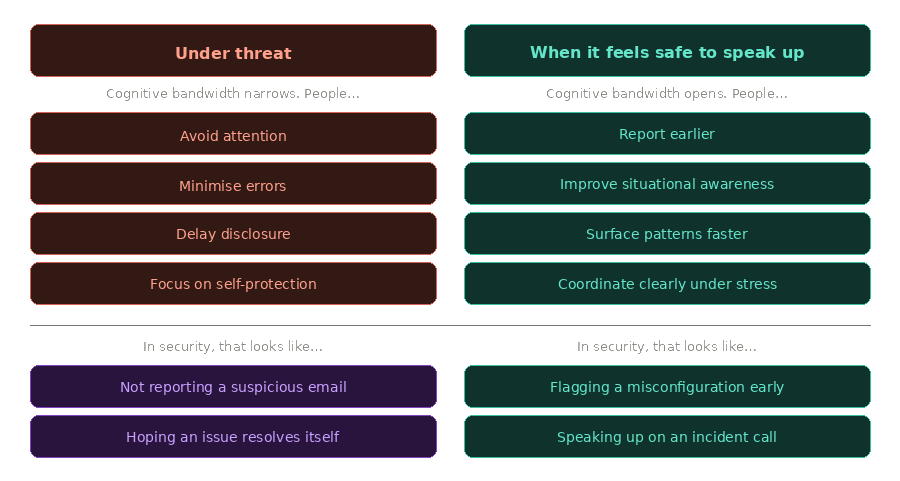
High-performing teams in crisis settings consistently show one common feature: members can speak up without fear of ridicule or punishment.
It may sound like idealism, but it is in fact the way information actually flows. There is no such thing as a perfect expert, not even in cybersecurity. Even seasoned professionals skip updates, reuse passwords under pressure, or misjudge a situation.
When vulnerability is normalised, learning accelerates. When it isn’t, people go quiet, and their silence hides risk.
Safety, on the other hand, often leads to transparency, which enables earlier detection and containment.
That is the link between psychological safety and cybersecurity culture.
What a psychologically safe security environment looks like
Psychological safety isn’t visible in values statements, but in everyday micro-moments.
Below are observable signals of a psychologically safe security environment, and why they help strengthen cybersecurity culture.
| Signal | What it looks like in practice | How it strengthens cybersecurity culture |
|---|---|---|
| People ask “basic” questions openly | “I’m not sure, can you check this?” | Removes hesitation, increases early detection, reduces silent errors. |
| Uncertainty is welcomed, not punished | Reporting a “maybe” is encouraged as much as reporting a confirmed threat. | Surfaces weak signals before incidents escalate. |
| Leaders model vulnerability | Managers admit mistakes and narrate learning. | Normalises transparency and reduces shame. |
| Mistakes are treated as information | Incidents and near-misses feed learning cycles, not blame cycles. | Improves pattern recognition and learning speed. |
Mistakes happen in every security team, with any type of cybersecurity culture. What separates the resilient ones is how quickly they make it to the surface.
How to build a psychologically safe security environment
Psychological safety is shaped, intentionally or not, by daily behaviour.
In cybersecurity, the forces inside the work environment consistently influence whether people speak up or stay silent. We've grouped these into five categories:
When these show up reliably, the environment itself becomes a defence layer.
Employee security awareness tools can’t create psychological safety on their own. But when paired with leadership behaviour and communication patterns, they can reinforce it, every single day.
This is where the design of your tools matters.
Clarity: people know what to do and what happens next
Most hesitation in workplace security reporting comes down to uncertainty, not apathy.
People stay silent because they're not sure if what they noticed counts, who to tell, or what happens once they do.
Remove that friction and behaviour changes. When someone understands what "suspicious" looks like in their context, how to report it, and what the feedback loop looks like afterwards, they act faster and second-guess themselves less.
Email checking and reporting tools such as MailRisk help make reporting not feel like a silent submission into a void.
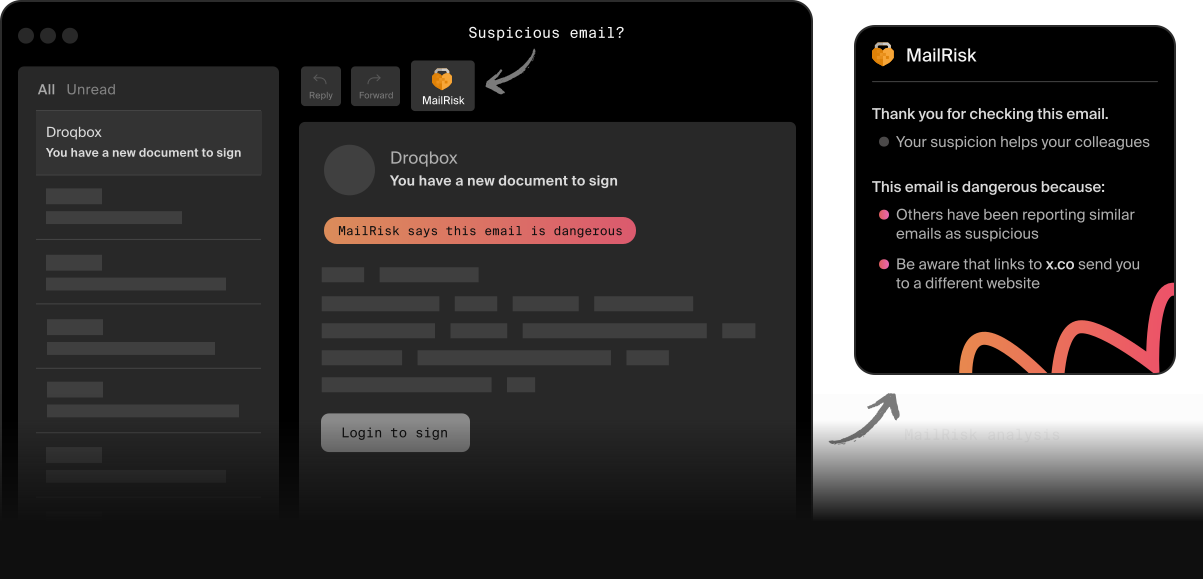
When someone flags an email, they receive clear, immediate feedback. That response reinforces the behaviour:
“Yes, this is how the system works, and yes, it was worth flagging.”
Candor: people can speak the truth without punishment
Hidden risk compounds, and risk stays hidden when people don't feel safe admitting mistakes.
Candor is a response to environment, not a personality trait. Removing punishment language from awareness materials, focusing on process rather than blame, asking "what made this harder than it needed to be?"—these are choices that signal honesty will be met with support rather than consequences.
In phishing simulations, for example, Secure Practice focuses debriefs on shared learning, rather than individuals who clicked.
That shift changes what people are willing to admit, and it has a true impact on the quality of their work.
When the goal is understanding rather than accountability, people become more honest about what confused them. And that honesty is where the real learning lives.
Curiosity: we ask before we judge
What may turn out to be risky behaviour or “human error”, almost always makes sense within its context.
One person reused a password because the alternative added ten minutes to an already overwhelming morning.
Another didn't flag the email because they weren't sure it met the threshold and didn't want to waste anyone's time.
These aren't failures of character, but signals worth following.
Preparedness-focused cybersecurity exercises create structured space for exactly this kind of exploration: low stakes, realistic scenarios, followed by genuine reflection on why the team responded the way it did and what would make the next decision easier.

MailRisk data can prompt the same conversations at a team level:
"We're seeing fewer reports from your department—can we look together at what's making it harder to flag things?"
Curiosity shifts security from enforcement to partnership. Partnership strengthens cybersecurity culture.
Commitment: leadership turns safety into practice
People don't believe what leaders say before a mistake. They believe what leaders do after one.
Commitment shows up in specific, observable ways: telling staff that anyone who reports a mistake in good faith won't be blamed for it, then proving it the first time someone does, protecting time for training even when things are busy, and investing attention in the teams who feel least safe to speak up.
A values statement means little without a pattern of behaviour to back it up.
By tracking and reporting on human risk, leaders can move beyond vanity metrics.
If security incident reporting is encouraged in theory but punished in practice, psychological safety starts to crumble.
Consistency: people can rely on how security responds
Inconsistency sends its own message. If one incident results in public blame and another in supportive coaching, people learn that the environment is unpredictable. And unpredictability, over time, produces silence.
Consistency means using the same tone across campaigns and incident communications, handling similar situations in similar ways, and maintaining regular rhythms of feedback so people know what to expect.
That reliability, built up across dozens of small interactions, is what workplace trust actually is. And trust is what makes a security culture function.
Stronger cybersecurity culture begins with how mistakes are handled
Security culture gets built in conversations: in debriefs, in reporting moments, in the tone of a message sent at 11pm during an incident call when everyone is stressed.
Psychological safety is the condition that allows everything else to work as intended. Every security team makes mistakes. The question is how long they stay hidden, and that depends almost entirely on whether people feel safe enough to surface them.
When they do, risk becomes visible sooner. And visible risk is manageable risk.
If you want to make it easier for your team to surface it, let's talk.
FAQs about psychological safety in cybersecurity culture
What is psychological safety in cybersecurity?
Psychological safety in cybersecurity means employees feel safe raising concerns, reporting incidents, admitting mistakes, and asking questions without fear of punishment or ridicule. It improves transparency and strengthens cybersecurity culture.
Why do people hesitate to report security incidents?
People often hesitate due to fear of embarrassment, punishment, or being seen as incompetent. Lack of clarity about reporting processes also increases hesitation.
Some organisations have begun correlating phishing report rates with work environment data—and the patterns are telling. High workload pressure, unclear expectations, and weak team cohesion all show up as predictors of low report rates.
How does psychological safety influence security behaviour?
Psychological safety is likely to increase reporting speed, improve communication during incidents, and reduce defensive behaviour. This leads to earlier detection and stronger security behaviour across teams.
How is psychological safety different from a compliance-based security culture?
Compliance-based security culture focuses on rule-following and audit requirements. Psychological safety focuses on openness, transparency, and early risk visibility. It supports deeper engagement rather than minimal adherence.
What are the biggest barriers to building cybersecurity culture?
Common barriers include weak leadership support, poor communication, lack of clarity around expectations, and fear-based environments that suppress reporting.
Can psychological safety reduce burnout in cybersecurity teams?
Yes. When teams can admit uncertainty and share responsibility without fear, stress decreases and collaboration improves, which can reduce burnout in high-pressure environments.
Stronger cybersecurity begins with how people feel at work, and how safely they can speak up when something doesn’t look right.


